
For many Registered Training Organisations, internal audit has traditionally been treated as a compliance housekeeping activity: check the policies, sample a few student files, confirm trainer credentials, note some gaps, assign actions and move on.
That model is no longer enough.
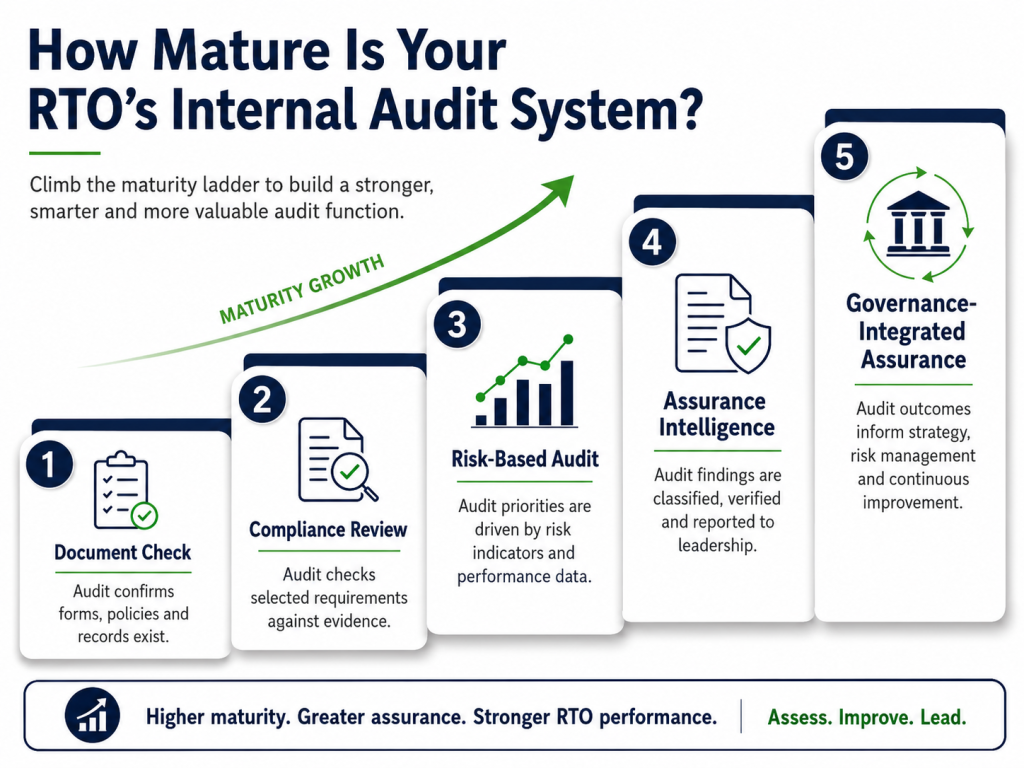
Under the 2025 Outcome Standards, RTOs need to demonstrate that governance, risk management and continuous improvement are active operating disciplines. Internal audit must therefore evolve from a periodic compliance check into a structured assurance mechanism that helps leaders understand whether the organisation’s systems are working in practice.
The friction point is clear: many RTOs are still auditing documents when the real risk sits in implementation.
A policy may exist. A procedure may be approved. A template may be current. But can the RTO show that the process is consistently implemented across trainers, cohorts, delivery sites, assessment methods, student support interactions and third-party arrangements? Can the leadership team see where evidence is weak before it becomes a regulatory finding? Can corrective actions be verified as effective, not just marked complete?
That is the new internal audit challenge.
The Problem: Evidence Exists, But Assurance Is Weak
In our work with RTO teams, one of the most common patterns is the “evidence pile” problem. The RTO has many records, registers, screenshots, forms and reports, but the evidence is not organised into a defensible assurance story.
This creates three operational vulnerabilities.
First, audit planning is too broad. Instead of targeting high-risk areas, the audit program repeats the same annual cycle regardless of changes to scope, staffing, complaints, validation outcomes, assessment performance or third-party activity.
Second, findings are not always evidence-based. Internal audit reports may state that a process is “inadequate” or “not consistently followed”, but fail to link the finding to specific criteria, objective evidence, sample details and risk impact.
Third, corrective actions close too early. A manager updates a form, sends an email or reminds staff of the procedure, and the action is marked complete. But the RTO has not tested whether the underlying issue has been resolved or whether the risk is likely to recur.
This is why internal audit must be repositioned as compliance intelligence.
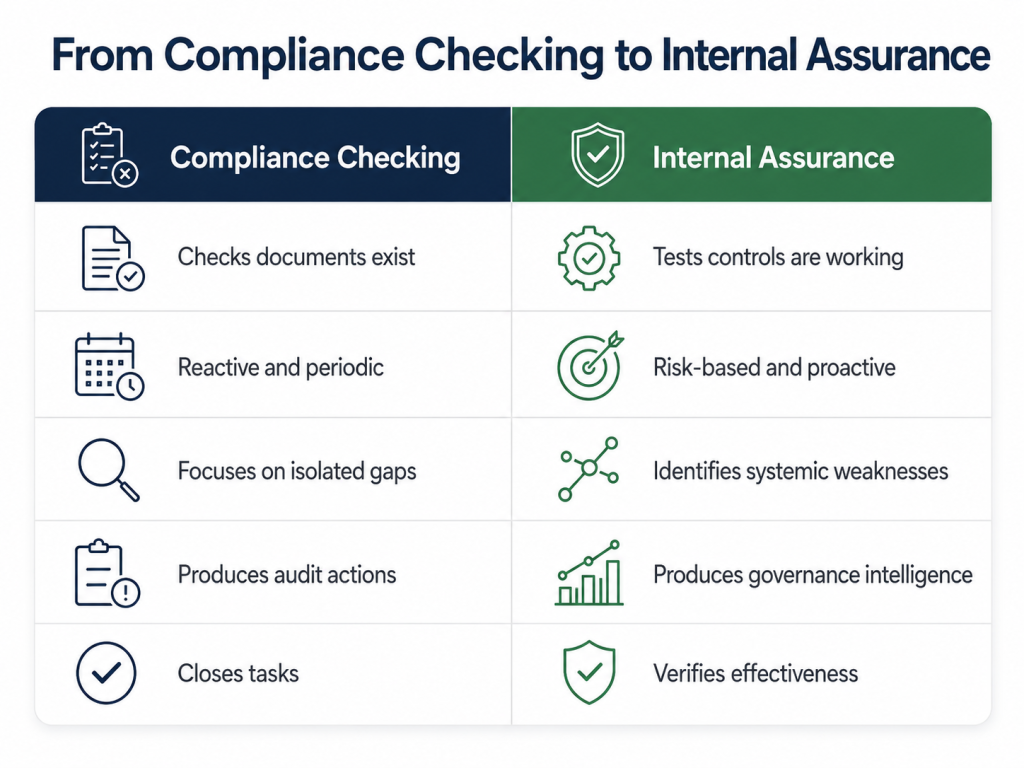
The Shift: From Audit Activity to Assurance Architecture
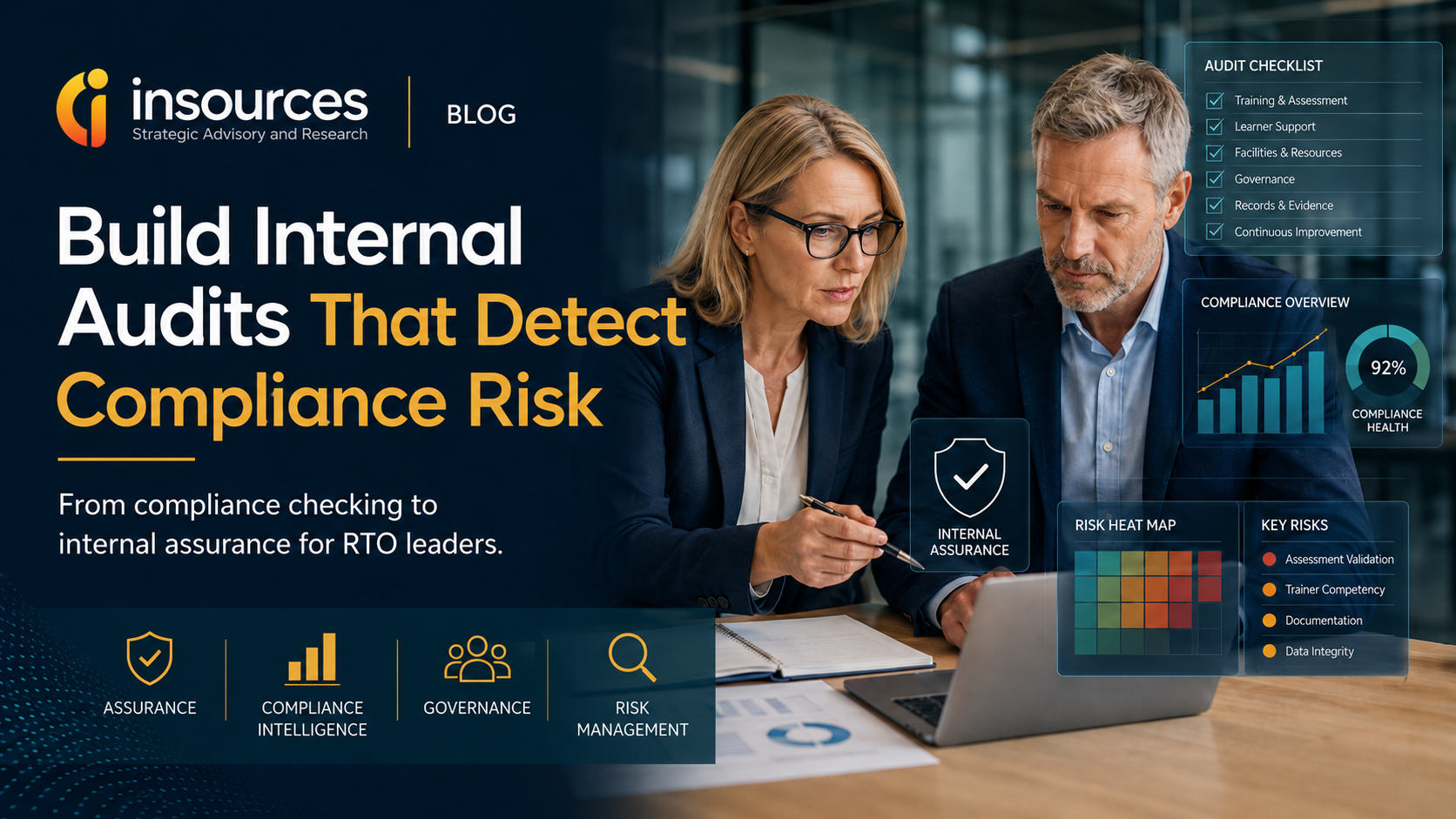
During the architectural design of our latest professional development program, Build Internal Audits That Detect Compliance Risk, our consulting team identified a critical distinction: effective RTO audit systems are not built around checklists; they are built around decision-quality evidence.
A checklist may help organise the audit. It does not, by itself, create assurance.
A stronger internal audit model asks:
-
What risk are we testing?
-
Which standard, policy, procedure or operational control is the audit criteria?
-
What evidence would prove the control is working?
-
What sample will give us reasonable confidence?
-
What would indicate a systemic weakness?
-
What must leadership know to make an informed decision?
This is where RTO internal audit becomes a governance enabler rather than an administrative task.
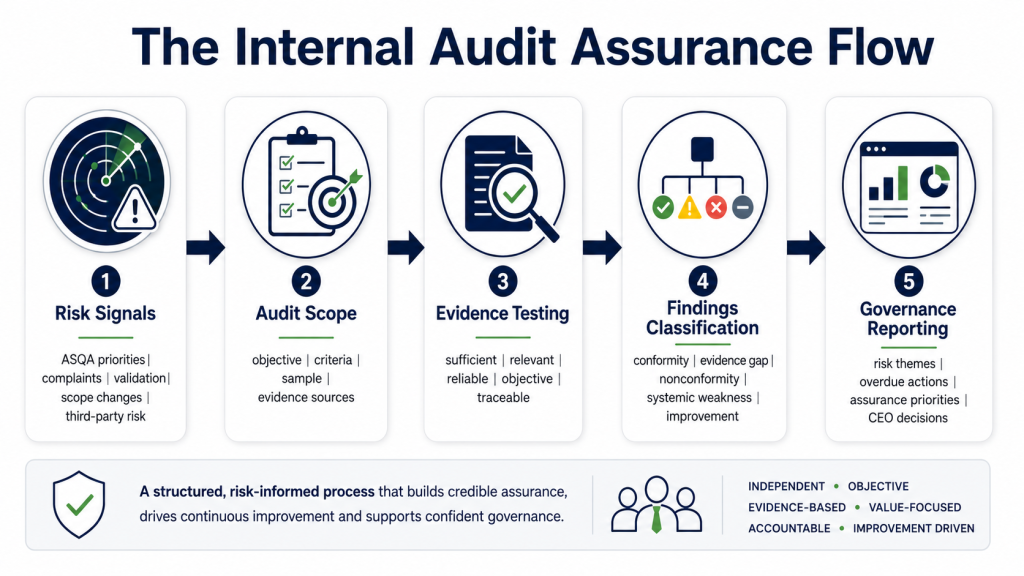
A Three-Step Framework RTOs Can Apply Immediately
Step 1: Build a Risk-Based Audit Planning Map
Start with risk, not the calendar.
A risk-based audit planning map should draw from both external and internal intelligence. External signals include ASQA risk priorities, changes to regulatory requirements, sector integrity concerns and changes in training products. Internal signals include previous audit findings, validation outcomes, complaints, appeals, learner feedback, student progression data, staff turnover, third-party changes and new delivery sites.
A practical audit planning map should include:
audit area or process
regulatory exposure
evidence weakness
student impact
operational complexity
recent change triggers
previous findings
proposed audit frequency
leadership priority rating
For example, an RTO with high RPL volume, recent assessor turnover and aggressive marketing claims should not wait for the annual assessment audit. RPL should become an immediate audit priority, because the risk profile has changed.
Step 2: Define the Audit Scope Before Collecting Evidence
Many internal audits lose value because the scope is too vague. “Review assessment compliance” is not an audit scope; it is a broad intention.
A defensible audit scope should define:
the audit objective
the audit criteria
the sample population
the sample rationale
evidence sources
staff to be interviewed
systems to be accessed
exclusions and limitations
reporting audience
For example, a stronger objective would be: “Determine whether sampled assessment tools for selected units are consistent with the training product, reviewed before use, and capable of producing valid and reliable assessment judgements.”
That objective tells the auditor what to test, what evidence to seek and how to frame findings.
In our deep-dive professional development sessions with RTO teams, the most common breakthrough happens when participants stop asking “what documents should I check?” and start asking “what evidence would give leadership confidence that this system is working?”
Step 3: Classify Findings by Evidence, Risk and System Impact
Not every issue is a non-compliance. Not every improvement opportunity is minor. Not every missing record is systemic.
A more mature internal audit process separates findings into clear categories:
Conformity: the requirement is met and supported by evidence.
Evidence gap: evidence is missing, weak, inconsistent or unreliable.
Nonconformity: the requirement is not met.
Systemic weakness: the issue appears across multiple samples, teams, cohorts or controls.
Opportunity for improvement: the requirement is met, but the system could be strengthened.
This classification discipline matters because it improves consistency of audit judgement. It also helps CEOs and governing persons focus on the right questions: Is this an isolated file issue, or a control failure? Does the risk sit with one trainer, one cohort, one third party, or the whole assessment system? Is the corrective action operational, strategic or governance-level?
Mini-Checklist: Is Your Internal Audit System Assurance-Ready?
Use this quick diagnostic with your compliance or leadership team.
Does your audit program prioritise high-risk areas, or simply repeat last year’s schedule?
Are audit objectives written using measurable verbs such as verify, determine, evaluate or assess?
Does each finding link to a specific standard, policy, procedure or operational requirement?
Is audit evidence recorded with source, date, sample details and traceability?
Are interviews triangulated with records, system data or observations?
Are findings classified consistently across auditors?
Are corrective actions linked to root cause?
Is corrective action effectiveness verified after implementation?
Are unresolved issues and evidence gaps reported to senior leadership?
Can the CEO use internal audit outcomes to support informed governance decisions?
If the answer to several of these questions is “not consistently”, the internal audit process is probably operating below its potential.
What CEOs Should Expect From Internal Audit Reports
A strong internal audit report should not be a long narrative of minor observations. It should provide leadership with a concise assurance snapshot.
At minimum, the CEO and governing persons should be able to see:
key risk themes
findings by standard or operational area
evidence gaps requiring attention
systemic weaknesses
overdue corrective actions
repeat issues
third-party risk indicators
actions requiring executive intervention
assurance priorities for the next quarter
This moves internal audit from a compliance archive to a live performance dashboard.
The Strategic Payoff
RTOs that build stronger internal audit capability gain more than audit readiness. They create a sharper management system.
They identify weak evidence earlier. They detect implementation drift across teams and sites. They improve consistency in assessment, validation, support, enrolment and third-party monitoring. They make corrective action more meaningful. They give CEOs clearer compliance intelligence before risk escalates.
Most importantly, they shift the compliance conversation from “Are we ready for audit?” to “Do we have reliable assurance that our systems are delivering the outcomes required?”
That is the leadership mindset the 2025 Standards demand.
Build This Capability Across Your Academic and Compliance Team
Internal audit is no longer just a compliance manager’s task. It is a whole-of-RTO assurance capability that connects governance, risk, training and assessment quality, student support, workforce management and continuous improvement.
Insources Institute’s upcoming professional development program, Build Internal Audits That Detect Compliance Risk, has been designed to help RTO teams scale this capability across their academic and compliance functions. The program works through practical tools including a Risk-Based Audit Planning Map, Internal Audit Scope Builder, Audit Evidence Collection Checklist, Evidence Gap Register, Findings Classification Guide, Corrective Action Verification Tracker and Governance Reporting Snapshot.
For RTOs navigating the Outcome Standards, the next maturity step is clear: build internal audits that detect risk early, produce defensible evidence and give leadership the compliance intelligence needed to act with confidence.