RTO Internal Audit and Self-Assurance
Knowing your RTO’s compliance status is no longer a “nice to have”. Under the 2025 Standards, ASQA expects RTOs to run a living self‑assurance system—with systematic monitoring, evaluation, and risk management embedded into business-as-usual.
The problem? Many RTO leaders only get a clear, independent view of compliance when a regulator initiates activity. By then, the cost of non-compliance is measured in disruption, reputation, and avoidable remediation.
We provide a fully independent internal audit that gives you:
- Real-time compliance visibility (not “audit-day surprises”)
- A risk-based view of what matters most to outcomes and integrity
- A practical uplift roadmap to strengthen your systems, capability, and compliance culture
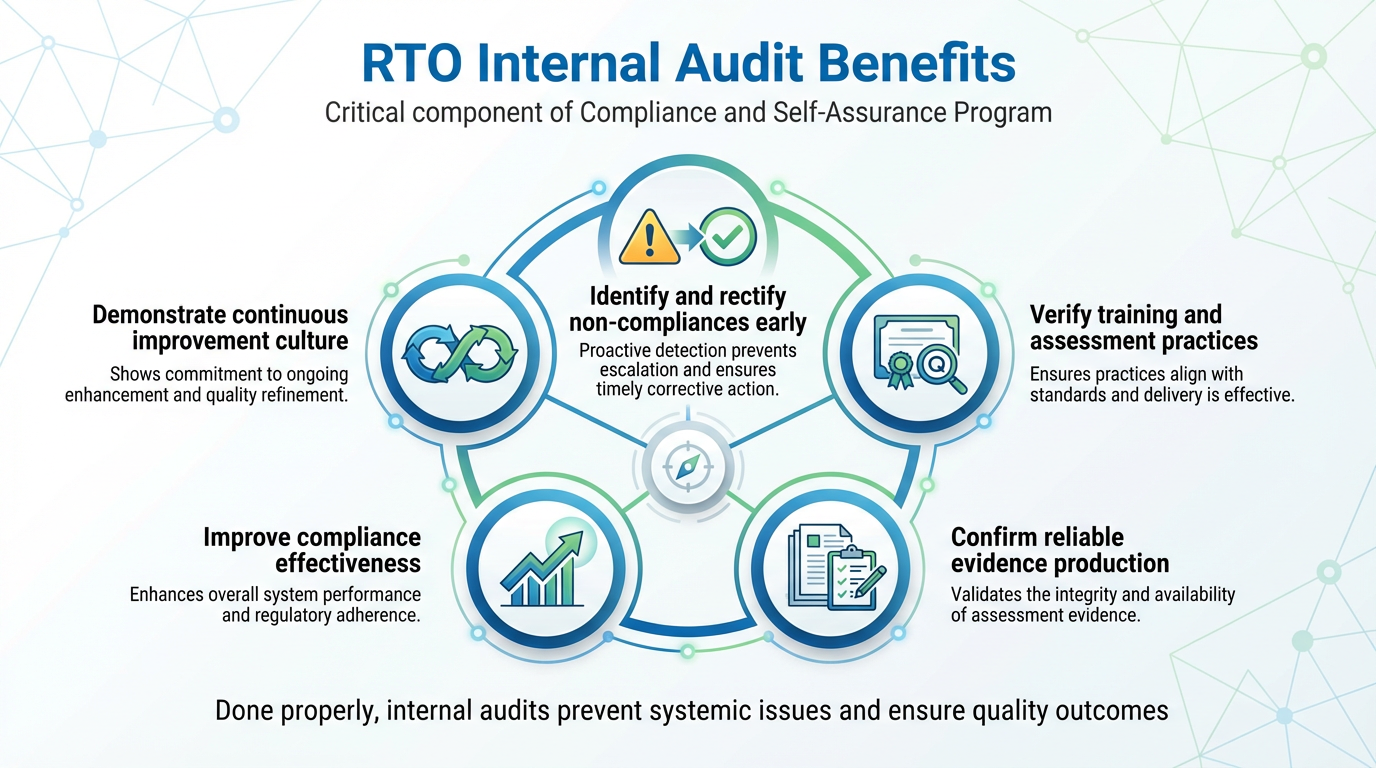
Internal audits are a critical component of an RTO Compliance and Self‑Assurance Program. Done properly, they help you:
- Identify and rectify non-compliances early—before they become systemic
- Verify that training and assessment practices are delivering intended outcomes
- Confirm your systems are producing reliable evidence (not just “good intentions”)
- Improve the effectiveness of compliance, quality, and governance processes
- Demonstrate an active culture of monitoring, evaluation, and continuous improvement
RTO managers are under pressure to deliver quality outcomes, maintain integrity, and keep the organisation audit-ready—often with lean teams and competing priorities. Common pain points include:
-
“We don’t know where we stand until ASQA tells us.”
Compliance risk sits in blind spots until it becomes urgent. -
“Evidence is everywhere.”
Critical evidence is scattered across systems, people, and folders—making it hard to prove quality and control. -
“We’re busy, so monitoring slips.”
Continuous improvement becomes reactive firefighting rather than a disciplined assurance cadence. -
“Our risk register doesn’t connect to compliance.”
Risks are documented, but not clearly tied to clauses, training delivery realities, or governance decisions. -
“Third‑party oversight is hard to operationalise.”
Agreements exist, but monitoring and evaluation of delivery quality is inconsistent. -
“We need board-ready reporting.”
Governing persons want confidence: clear findings, risk ratings, and an action plan—not a document dump.
We turn compliance into an operating system: measurable, monitorable, and defensible. Our internal audit service helps you:
- Build a self‑assurance engine that systematically monitors performance across operational functions.
- Establish a risk-based audit program aligned to your scope, cohorts, delivery modes, and compliance risk profile
- Create a single source of truth for evidence: what you have, what’s missing, and what needs strengthening
- Produce audit reports that drive action, with prioritised corrective actions, owners, and timeframes
- Strengthen governance with board-ready insights: risk themes, root causes, trends, and assurance status
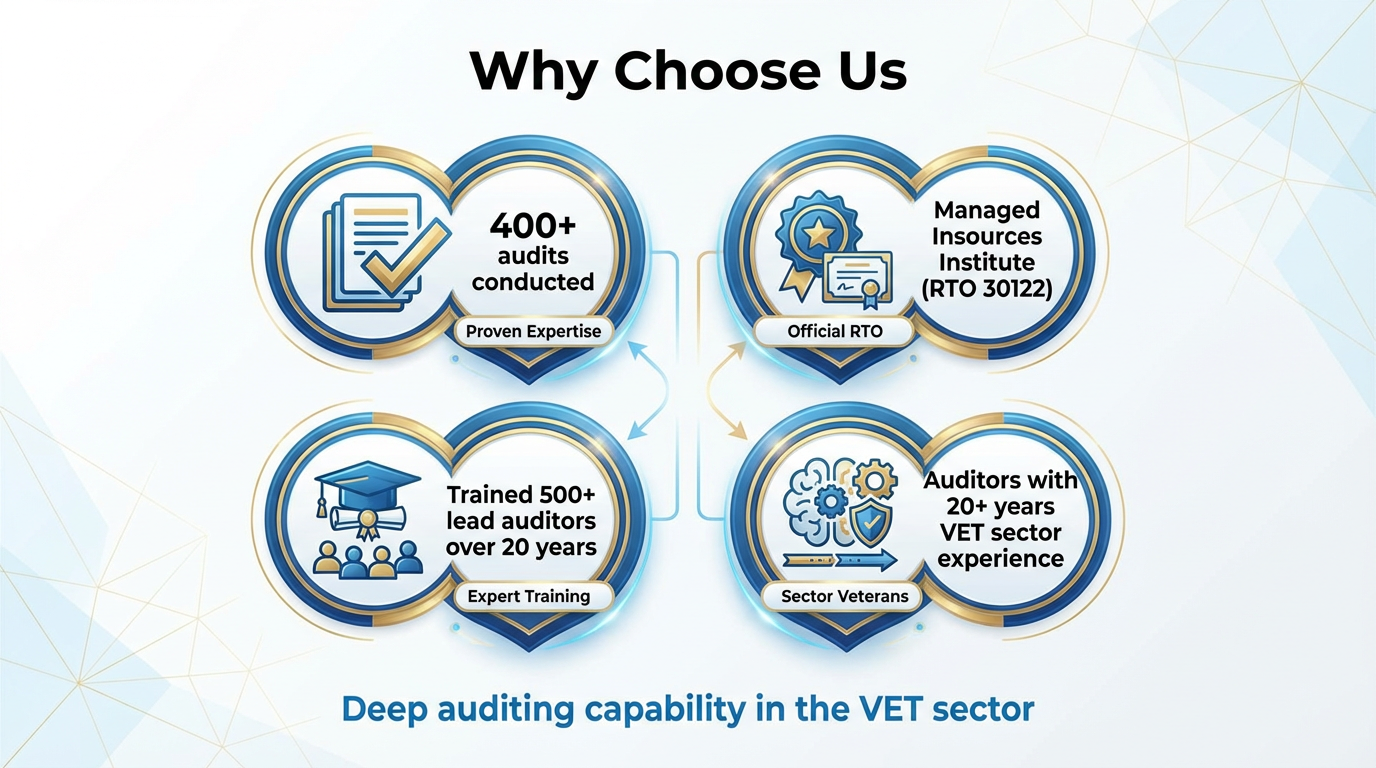
We’re a leading consulting and training organisation with deep auditing capability in the VET sector.
- 400+ audits conducted
- Managed Insources Institute (RTO 30122), delivering the Diploma of Quality Auditing
- Trained 500+ lead auditors over the last 20 years
- Auditors with two decades of VET sector experience—working for and within the system
Our focus is simple: give you credible assurance, clear priorities, and a practical pathway to uplift compliance performance.
Internal audits are a critical part of an RTO Compliance Program used to monitor performance against compliance requirements. RTO internal audits help managers to identify and rectify non-compliances before those non-compliances become a threat for the RTO’s future. Internal audits programs help RTOs to evaluate and improve the effectiveness of compliance, quality, and governance processes.
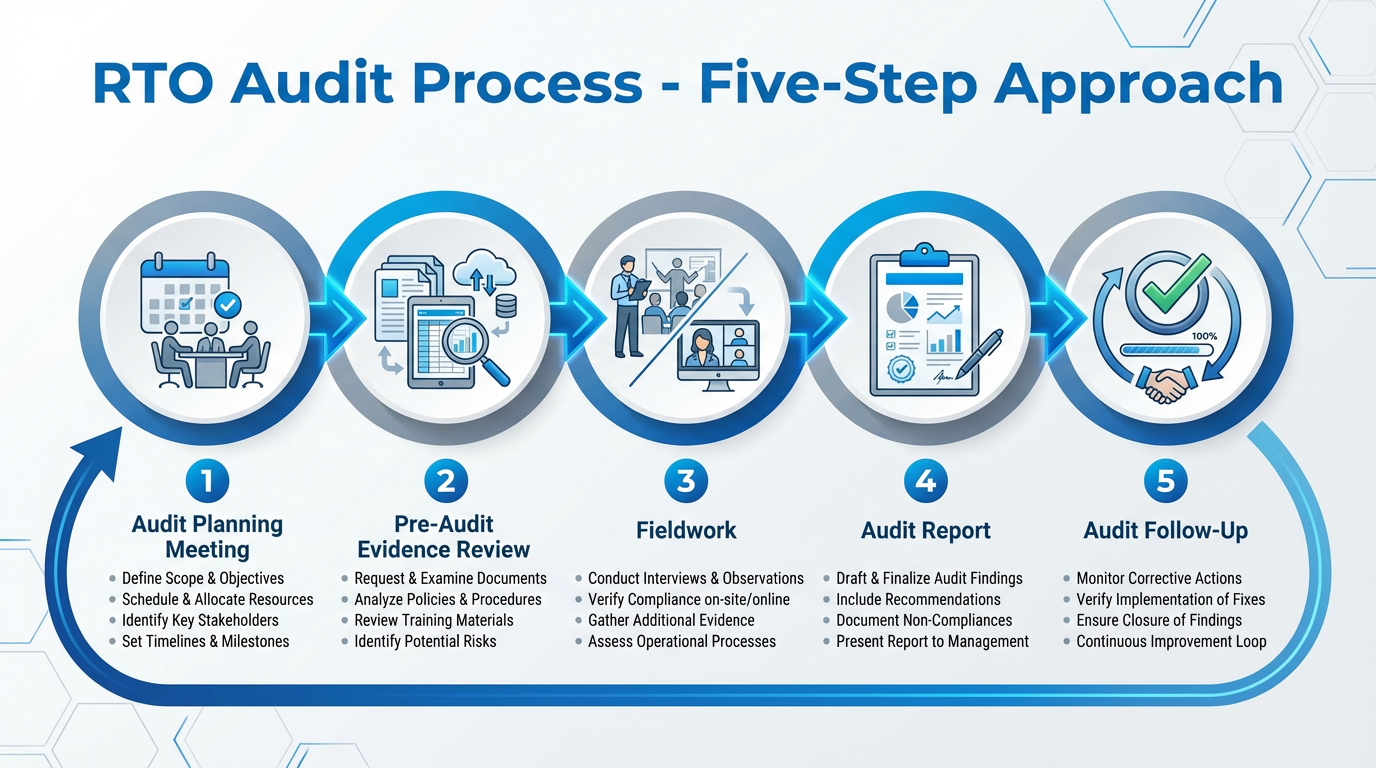
An internal audit is more than fieldwork. Our method follows a structured five-step approach aligned with recognised auditing and internal assurance good practice:
- 1. Audit planning meeting. We clarify scope, risks, priorities, delivery context, and evidence pathways.
- 2. Pre‑audit evidence review. We review documents and data early, so fieldwork targets what matters.
- 3. Fieldwork (online or onsite). Interviews, evidence testing, sampling, and practice verification.
- 4. Audit report. Clear findings, risk-rated issues, root causes, and improvement recommendations.
- 5. Audit follow‑up. We validate actions taken and help you close the loop—so improvements stick.
Most RTOs maintain an annual audit program that maps internal audits across the calendar year, with scope and criteria driven by your RTO-specific compliance risk profile. A high-performing program uses a strategic mix of targeted audits—sampling different training products, delivery modes, sites, cohorts, and standards—so leadership gains an enterprise-wide view of compliance performance (not just a snapshot).
Option 1: Full internal audit (single engagement)
A comprehensive review across the agreed scope that provides a complete compliance performance baseline and a prioritised improvement roadmap. This option is ideal when you need a consolidated view for governance reporting, re-registration readiness, or to reset your compliance position.
Option 2: Six targeted audits across the year (bi‑monthly cadence)
A structured series of six targeted audits delivered approximately every two months, aligned to your risk profile and operational priorities. This approach creates a steady, manageable assurance rhythm and supports continuous improvement as an ongoing operating cycle.
Splitting the program into bi‑monthly audits reduces the operational burden of receiving all findings at once. Instead of an overwhelming volume of corrective actions and data, your team receives a focused set of insights every two months—making it easier to:
- triage and rectify issues faster,
- process evidence and implement improvements with less disruption,
- track progress and close actions progressively, and
- demonstrate ongoing monitoring and continuous improvement over time.
Your audit program remains responsive to change—scope updates, staffing shifts, new cohorts, funding contract requirements, third‑party delivery arrangements, and evolving regulator focus areas. The outcome is both practical and strategic: a current, risk-based picture of compliance performance that supports:
- Regulatory reporting (e.g. Annual Declaration on Compliance)
- Readiness for regulated projects (e.g. re‑registration, adding to scope)
- Self‑assurance and continuous improvement planning, with actions managed in achievable cycles
- Governance oversight and risk management decision-making, backed by documented assurance activity
Next step
Engage us for a targeted internal audit or a full-year risk-based audit program. You’ll walk away with clarity on compliance status, confidence in evidence, and an actionable plan to strengthen outcomes, integrity, and governance.
RTO Internal Audit Options
Our standard RTO audit packages are:
This audit provides RTOs with an audit report and action plan to confidently prepare the CEO Annual Declaration on Compliance, or the preparation for a re-registration process.
The full RTO Standards audit usually includes 1-2 days fieldwork (depending on the RTO's scope of registration and other conditions such as locations, or number of students).
This audit provides CRICOS RTOs with an audit report and action plan to confidently prepare an application for CRICOS, or in preparations for RTO/CRICOS re-registration.
The full RTO Standards audit usually includes 2-3 days fieldwork (depending on the RTO's scope of registration and other conditions such as locations, or number of students).
This audit provides RTOs with an audit report and action plan to effectively monitor compliance, strength self-assurance by providing a third line of protection, and continuously improve the RTO compliance systems and capabilities.
The partial RTO Standard 1 audit includes 1-day fieldwork.
All audits (Full RTO Standards audit, Full RTO Standards + CRICOS audit, Partial RTO Standard 1 audit) includes expert advice that goes beyond a standard compliance report. We provide examples of best practices, an action plan to rectify any identified non-compliances, and exploit opportunities for continuous improvement.