
Student support has entered a new era in vocational education. Under the 2025 Standards for RTOs, it is no longer enough to show that support services exist somewhere in a handbook, on a website, or in a generic enrolment pack. RTOs must be able to demonstrate how learner needs are identified, how support decisions are made, how support is implemented, and how progress is reviewed. The 2025 Standards set clearer expectations for quality outcomes, student support and provider self-assurance.
For RTO leaders, this is a strategic governance issue. For compliance managers, it is an evidence architecture issue. For trainers and assessors, it is a decision-quality issue. For students, it is the difference between being technically offered support and actually receiving the right support at the right time.
Support activity is not the same as support assurance
Most RTOs can point to student support services. They can show a policy, a list of referral contacts, an LLN tool, trainer access arrangements, perhaps even a reasonable adjustment form. The weakness is not usually the complete absence of support. The weakness is fragmentation.
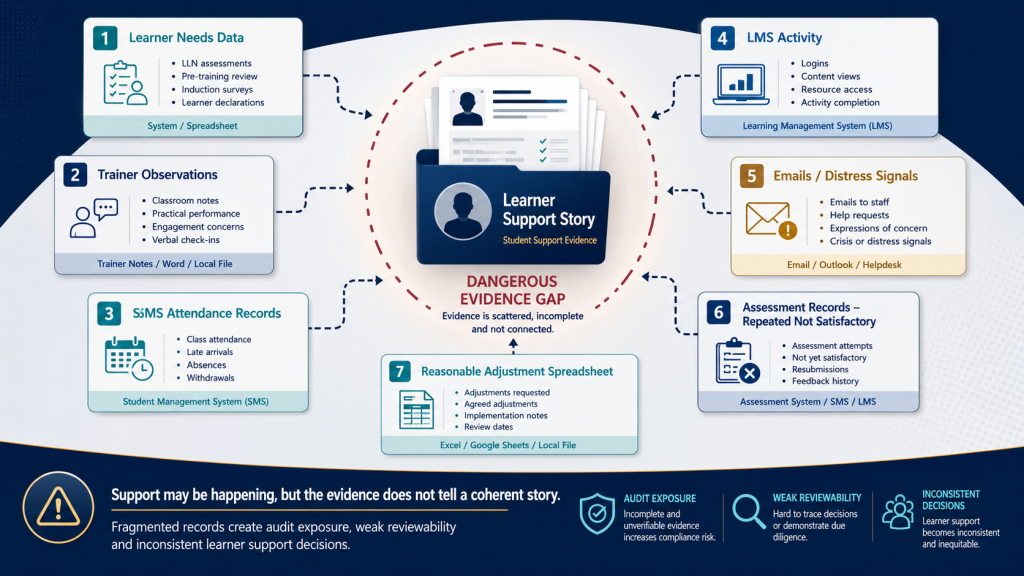
Learner needs data sits in one location. Trainer observations sit somewhere else. SMS records capture attendance, the LMS captures activity, emails capture distress signals, assessment records capture repeated Not Satisfactory outcomes, and reasonable adjustment decisions may sit in a spreadsheet no one regularly reviews.
This creates a dangerous gap. The RTO may genuinely be trying to support the learner, but the evidence does not tell a coherent story.
ASQA’s training support guidance for Standards 2.3 and 2.4 focuses on how RTOs determine training support services for students, make those services available, provide access to trainers and other staff, respond to student queries, support disclosure of disability, and implement reasonable adjustments where appropriate. That is not a passive documentation requirement. It is an operational control requirement.
The practical compliance question is simple: if a student file is sampled tomorrow, can the RTO show the support decision from trigger to outcome?
Generic plans create audit exposure
Generic support plans often fail because they document a category, not a decision. They say “LLN support required” but do not identify what triggered the need, what support was selected, who was responsible, when it was reviewed, whether the student engaged, or whether the strategy worked.
That becomes more serious when support intersects with assessment. A trainer may want to help a learner with disability, anxiety, low literacy or digital access barriers. But if the support response changes the assessment task without checking the training product requirements, principles of assessment and rules of evidence, the RTO may unintentionally undermine assessment validity.
Reasonable adjustment is not a licence to reduce competency evidence. It is a mechanism to support equitable access and participation while preserving the integrity of the assessment judgement.
This is where many RTOs are exposed. A student’s need is identified, but the response is informal. A trainer makes a well-intentioned adjustment, but approval is not recorded. A student expresses distress, but there is no referral record. A learner repeatedly misses workshops, but no intervention trigger activates. A CALD learner copies online material because they do not understand assessment instructions, but the record treats it only as academic misconduct rather than a combined LLN, digital literacy and assessment integrity issue.
NCVER’s 2025 research on student support reinforces that effective support is not a single service or form. It identifies six elements associated with effective student support: a whole-of-institution approach, early engagement, high-quality training by caring experts, continuity of support, holistic and individualised support, and strong relationship-building. The same research notes that support needs arise at multiple points across the learner journey, including pre-enrolment, commencement, ongoing study, assessment, work placement and nearing completion.
That matters because audit exposure often appears at the transitions. Suitability information does not flow to trainers. LLN results do not become support actions. Digital capability gaps are identified but not followed up. Attendance issues are monitored but not escalated. Assessment issues are treated separately from support planning. Wellbeing concerns stay in email threads rather than being triaged through a controlled process.
The student experiences this as inconsistency. The regulator may see it as weak implementation.
Build a student support assurance model
The way forward is not more paperwork. The answer is better operational design.
A defensible student support plan should do five things.
First, it should capture the trigger. This may be a suitability review, LLN result, digital skills screen, disability disclosure, trainer observation, attendance pattern, LMS inactivity, missed assessment, repeated Not Satisfactory outcome, work placement barrier, wellbeing concern, complaint or appeal.
It should define the support decision. RTOs need a practical decision matrix that distinguishes trainer-led learning support, LLN support, digital capability support, specialist referral, reasonable adjustment, progress intervention, wellbeing referral, employer engagement and management escalation.
It should assign responsibility. Under the 2025 operating model, vague accountability is a material risk. Trainers, assessors, support staff, administration teams and managers need clear role boundaries. This is particularly important where wellbeing concerns emerge, because trainers may identify and refer concerns but are not necessarily qualified to provide counselling or specialist intervention.
It should preserve assessment integrity. Any support response that affects assessment conditions, timing, format or evidence collection should include an integrity check. Does the adjustment preserve the requirements of the training product? Does it maintain fairness, flexibility, validity and reliability? Does it preserve validity, sufficiency, authenticity and currency of evidence?
It should close the loop. A plan without review is not assurance. RTOs should define review dates, review triggers, success indicators, evidence sources and escalation rules. Support plans should be connected to SMS/LMS data, assessment outcomes, complaints, appeals, risk registers and continuous improvement records.
This is also aligned with ASQA’s broader regulatory direction. ASQA describes its risk-based approach as using intelligence and data to identify, track and mitigate sector risks, and its 2025–26 priorities include areas such as shortened course duration, student work placement, RPL, academic integrity and other risks that intersect with student support, suitability and progression controls. ASQA’s revised Regulatory Assessment and Monitoring Approach, published in June 2026, also reinforces a risk-based regulatory model focused on quality outcomes and the integrity of VET.
Make support visible, consistent and reviewable
RTO executives should not treat student support planning as an administrative function owned only by support staff. It is a whole-of-RTO assurance mechanism.
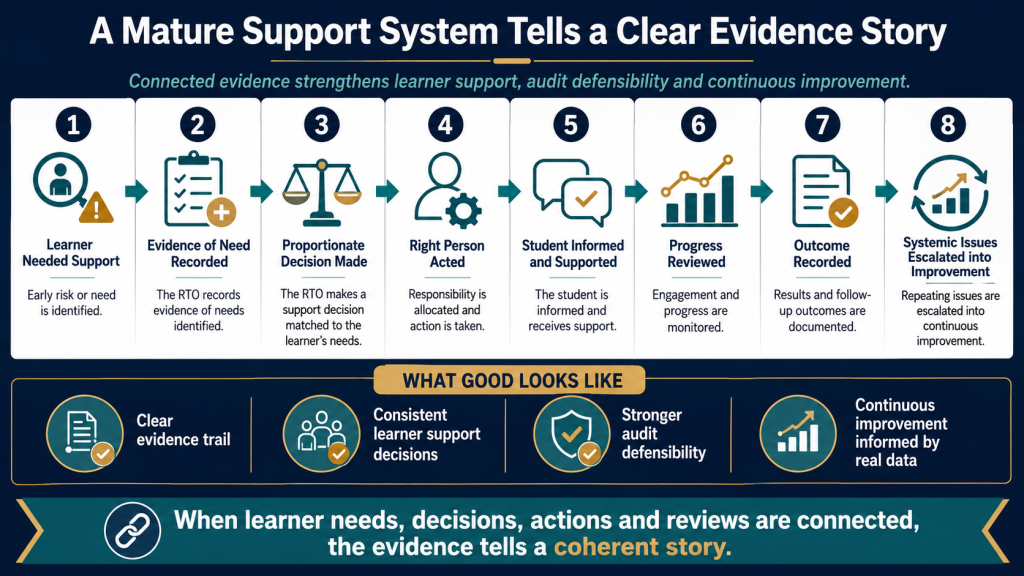
A mature support system tells a clear evidence story:
- The learner needed support.
- The RTO knew this because of documented evidence.
- The RTO made a proportionate decision.
- The right person acted.
- The student was informed.
- Progress was reviewed.
- The outcome was recorded.
- Systemic issues were escalated into improvement.
During the architectural design of our latest Insources Institute professional development program on this topic, our consulting team kept returning to one core insight: RTOs do not need bigger support forms; they need better support logic. The compliance uplift comes from connecting learner needs data to decision-making, implementation evidence and quality improvement.
That is the shift from student support as a service to student support as an assurance system.
Insources Institute’s upcoming professional development program, Build Student Support Plans That Stand Up in Audit, has been designed for RTO CEOs, Compliance Managers, Training Managers, Student Support Officers, Instructional Designers and Lead Trainers/Assessors who want to strengthen this capability quickly and practically.
The program focuses on translating LLN, digital capability, accessibility, wellbeing, cultural considerations and progress data into structured support plans that are actionable, evidence-based and reviewable. Participants work through practical templates, decision matrices, reasonable adjustment controls, progress intervention triggers and audit-readiness checks that can be adapted directly into an RTO’s QMS.
For RTOs navigating the 2025 Standards, the objective is not more paperwork. The objective is better operational control, stronger evidence and more consistent learner support decisions.