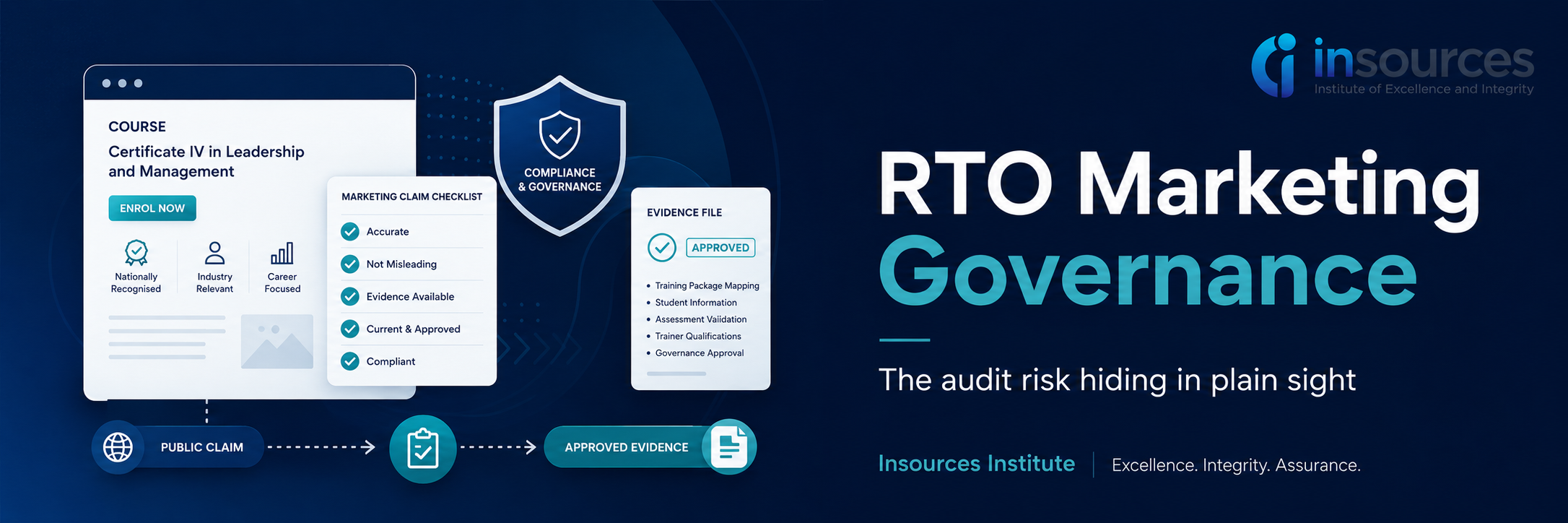

The 2025 Outcome Standards for RTOs represent more than a regulatory update—they reflect a shift in how quality and accountability are understood within the vocational education and training (VET) sector. For Registered Training Organisations (RTOs), this shift requires a transformation not only in compliance practices but also in leadership capability, system design, and operational integration.
To manage training design and delivery effectively under these new standards, RTOs must adopt an integrated approach that aligns regulatory compliance, industry responsiveness, and educational best practice. This requires moving beyond ad hoc compliance activities and toward a Quality Management System (QMS) that acts as a strategic decision-making framework—empowering staff to plan, deliver, and evaluate training with consistency and confidence.
From Fragmented Compliance to Integrated Planning
Too often, training and assessment strategies (TAS) are treated as paperwork exercises—reactive documents completed for audit purposes rather than dynamic tools for educational planning. Under the 2025 Standards, TAS must embody intentional, outcomes-focused design and be supported by an organisation-wide system that reinforces consistency and quality.
Your QMS should clearly define the purpose, scope, roles, and procedures for training and assessment design. For example, in our own framework, training design is anchored in the ADDIE model, ensuring training:
- addresses identified learning needs,
- aligns with national Training Packages,
- integrates stakeholder and industry input, and
- complies with both the VET Quality Framework and employer expectations.
This structured design ensures that training is not only fit for purpose but also documented, defensible, and adaptable—enabling providers to demonstrate educational integrity while also satisfying client, learner, and regulator demands.
Supporting Staff Through a Practical System
The 2025 Standards require providers to take greater responsibility for self-assurance and outcome evaluation. This puts pressure on staff to make sound instructional and compliance decisions in increasingly complex environments.
A comprehensive QMS supports this by:
- Embedding best practices through templates, workflows, and policy guidance.
- Clarifying roles and responsibilities across compliance managers, instructional designers, trainers, and assessors.
- Standardising processes to ensure training delivery, assessment design, and validation are aligned with internal and external quality benchmarks.
- Creating consistency across training products and cohorts, reducing regulatory risk.
Instead of relying on individual knowledge or memory, a strong QMS provides collective intelligence—a systematised approach to quality and compliance that any team member can follow with clarity and confidence.
A Capability-Based Response to Complex Priorities
Training providers today operate in a world shaped by digital transformation, diverse learner needs, and shifting regulatory expectations. Delivering quality training under these conditions requires leaders who can reconcile multiple competing priorities—not as dilemmas, but as design challenges.
- It’s not a choice between compliance and innovation, but a question of how to design programs that meet both.
- It’s not a conflict between duration (volume of learning) and cost, but a need to find viable models that honour regulatory, commercial, and learner realities.
- It’s not either validity or scalability in assessment, but both.
The key capability for RTOs in this next era will be the ability to design training ecosystems that are responsive, compliant, and sustainable. This requires systems thinking, strategic planning, and a QMS that acts not as a filing cabinet but as a dynamic framework for action.
Final Thought
As the 2025 Standards for RTOs take effect, it’s clear that training design and delivery can no longer be treated as isolated tasks or compliance afterthoughts. They must be approached as strategic capabilities—rooted in purpose, supported by systems, and aligned with the complex demands of today’s VET environment.
To explore this further, I invite you to join me for the upcoming webinar: How to Manage Training Design and Delivery under the 2025 Standards
In this session, I’ll unpack practical strategies for integrating compliance, learner outcomes, and business viability into a cohesive training approach. We’ll also examine how a robust Quality Management System can serve as a decision-making framework to guide your team and improve performance across the board.
Whether you’re a training manager, instructional designer, or compliance leader, this webinar will equip you with tools and insights to manage training with confidence and clarity in the new regulatory landscape.