
For many RTOs, marketing has traditionally been treated as a front-end business function: generate enquiries, promote courses, fill cohorts and support growth. Compliance was often brought in late, usually to check whether the RTO code appeared somewhere on the brochure or whether the training product title looked correct.
That operating model is no longer fit for purpose.
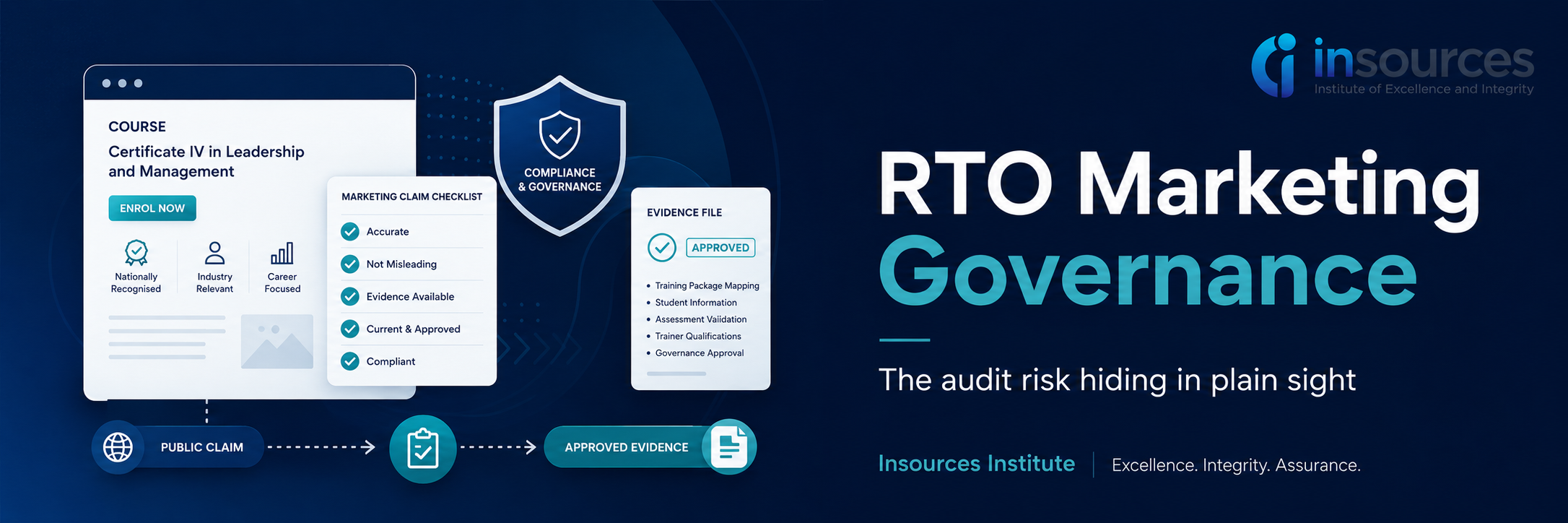
Under the 2025 regulatory framework, marketing is not merely communication. It is a public representation of the RTO’s services, training products, delivery arrangements, fees, funding conditions, support model, assessment requirements and student obligations. Every course page, flyer, email campaign, paid advertisement, third-party post and enrolment script can become evidence in an audit, complaint review, performance assessment or funding contract investigation.
The issue is not that RTOs are deliberately misleading students. In many cases, the real problem is weaker: fragmented ownership, outdated information, uncontrolled third-party messaging and marketing content that has drifted away from the TAS, scope of registration or actual delivery model.
That makes marketing governance one of the most practical assurance priorities for RTO leaders in 2025 and beyond.
The Problem: Marketing Claims Are Often Disconnected from Source Evidence
A high-performing RTO should be able to answer a deceptively simple question: How do we know that every public claim we make about a course is accurate, current, approved and supported by evidence? For many providers, the answer is uncomfortable.
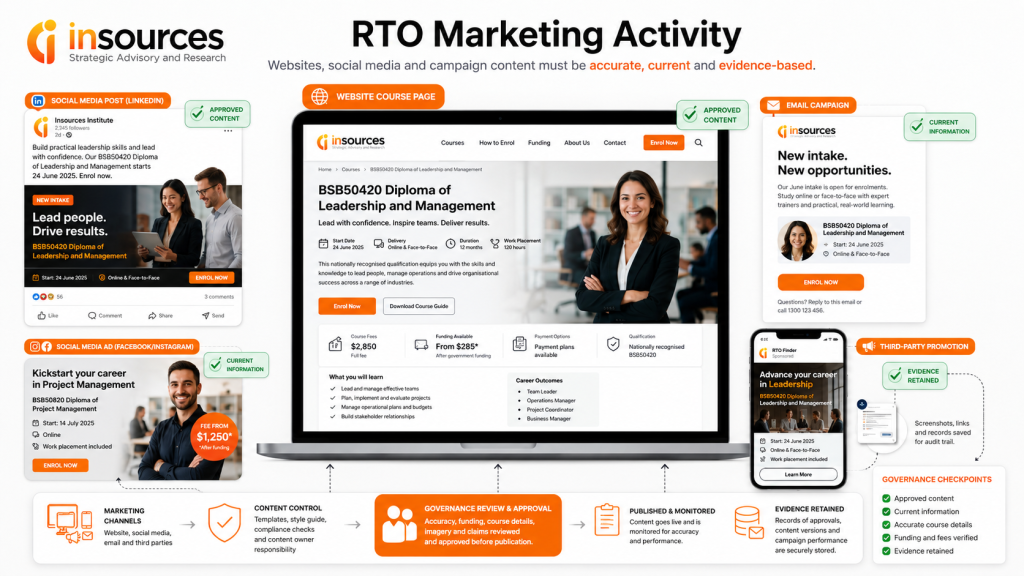
The website might state that a course is “flexible online learning”, while the TAS requires mandatory workshops and supervised practical assessment. A brochure might say “government funded places available”, but fail to explain eligibility, student contribution fees or the impact on future entitlement. A campaign might promote “guaranteed work placement”, without disclosing pre-placement requirements such as police checks, immunisation evidence, workplace suitability or provider capacity limitations.
A third-party recruiter might go further and advertise “job guaranteed”, “no assessments”, “complete in weeks”, or “free course”, exposing the RTO to risks it did not create directly but remains accountable to control.
This is where marketing becomes a governance issue, not a branding issue.
The 2025 Outcome Standards require accurate and current information for VET students, including information provided by third parties. They also require effective governance, risk management, clearly understood roles and responsibilities, and systematic monitoring and evaluation. The Compliance Standards go further by dealing directly with marketing and advertising, guarantees, inducements, third-party arrangements, NRT logo use, transition of training products and compliance with applicable laws.
The Agitation: Small Wording Gaps Can Create Large Regulatory Exposure
Marketing risk is rarely caused by one dramatic failure. It usually accumulates through small, untested claims. Consider these common examples:
- “Complete in 12 weeks” when the TAS describes a 38-week structured program.
- “Fully online” when practical workshops or workplace observation are mandatory.
- “No entry requirements” when suitability, LLN or digital literacy checks are required.
- “No hidden costs” when screening checks, uniforms, equipment or placement costs may apply.
- “Pathway to licence” when the RTO has not obtained confirmation from the relevant industry regulator.
- “RPL in two weeks” when the assessment system cannot validly support that timeframe for most candidates.
- “Job guaranteed” when employment outcomes sit outside the RTO’s control.
- “Delivered in partnership” without clarifying whether the third party recruits, trains, assesses or simply provides information.
These claims may look commercially attractive, but they create a high-risk gap between what is promised, what is approved, what is delivered, and what can be evidenced.
This gap matters because prospective students rely on marketing information to make enrolment decisions. If marketing overstates convenience, understates obligations, omits costs or misrepresents outcomes, the RTO may create student detriment before training even commences.
For RTO Chief Executives, the strategic risk is broader. Marketing failures can compromise brand trust, trigger complaints, undermine regulatory confidence, expose weak internal controls, and reveal that governance has not kept pace with growth or channel complexity.
During the design of our latest Insources Institute capability program on Build RTO Marketing Governance, our consulting team noted a recurring pattern across RTO environments: marketing content was often reviewed as a document, but not controlled as a system. That distinction is critical.
- A document check asks, “Does this brochure look compliant?”
- A governance system asks, “What source evidence supports each claim, who approved it, what changed since approval, where is the version record, and how do we know third parties are using the correct material?”
Only the second question is audit-defensible.
The Solution: Build a Marketing Governance Control Environment
RTOs do not need bureaucratic bottlenecks. They need a practical, risk-based marketing governance model that protects students, supports growth and gives management confidence.
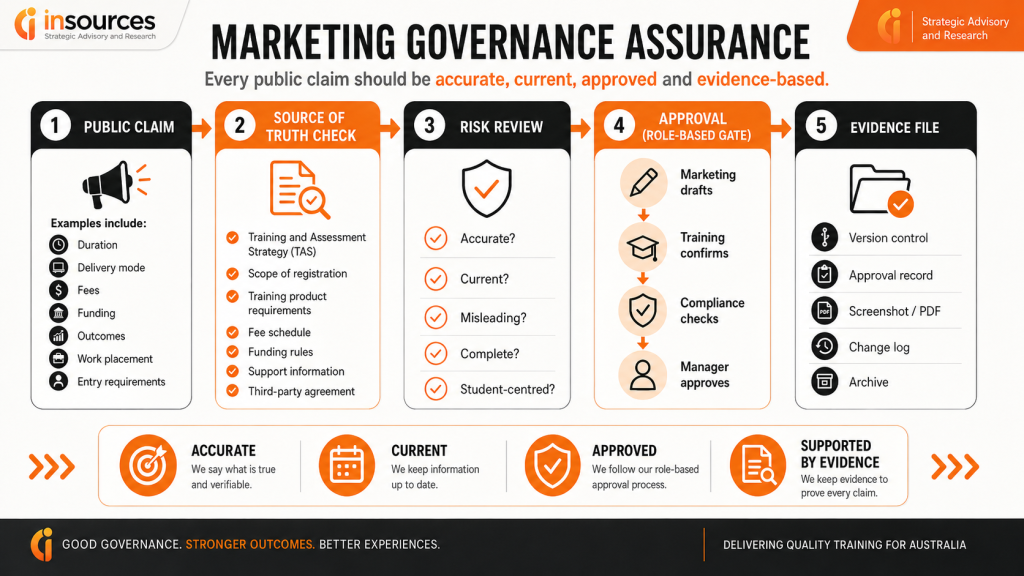
A mature model has five core controls.
1. Define Marketing as Regulated Service Information
Marketing governance starts by expanding the asset register. It should include website pages, brochures, digital advertisements, social media campaigns, course guides, information session slides, enrolment templates, automated emails, third-party pages and archived versions.
The control question is: Do we know what is currently in circulation?
If the RTO cannot identify all live marketing assets, it cannot effectively assure their accuracy.
2. Establish Source-of-Truth Evidence
Marketing should never be the primary source of truth. Claims must be tested against approved operational evidence, including:
- scope of registration;
- training product requirements;
- current TAS;
- delivery and assessment strategy;
- approved delivery locations and modes;
- fee schedule and refund policy;
- funding contract rules;
- support services model;
- work placement requirements;
- licensing or industry regulator advice;
- third-party agreements.
The principle is: no evidence, no claim.
3. Use a Claim Risk Filter Before Publication
Every marketing claim should be tested for risk. High-risk claim categories include duration, funding, fees, RPL shortcuts, employment outcomes, licensing outcomes, work placement guarantees, assessment simplicity, online delivery and third-party involvement.
A practical claims filter should classify risks as low, moderate, high or critical. Critical claims should trigger removal, senior escalation and corrective action, particularly where guarantees or unsupported outcomes are implied.
This is especially important for enrolment and marketing teams, because risk often enters through persuasive wording rather than technical non-compliance.
4. Align Course Pages to the TAS
The TAS-to-marketing relationship is one of the most valuable controls an RTO can implement.
A course page should align with the TAS on duration, delivery mode, learning structure, assessment methods, placement requirements, entry and suitability expectations, resources, support and student obligations.
Where the TAS changes, marketing review must be triggered. Where the scope changes, marketing review must be triggered. Where fees, funding, delivery locations, third-party arrangements or training product status change, marketing review must be triggered.
A calendar-based review cycle is useful, but not sufficient. Marketing governance must be event-triggered.
5. Control Third-Party Promotion
Third-party marketing is one of the most exposed areas of RTO operations because the RTO may not be writing the copy, but remains accountable for the representation made on its behalf.
A robust third-party marketing control should confirm:
- the written agreement defines recruitment and promotional boundaries;
- the third party uses only approved assets;
- the RTO approves all public representations before publication;
- third-party materials disclose which services are provided by whom;
- the third party does not make guarantees, misuse branding or imply unsupported outcomes;
- the RTO monitors live channels and retains screenshots;
- outdated materials are removed promptly;
- issues are captured in the risk or continuous improvement register.
The objective is not to slow down growth. It is to scale responsibly.
A Practical Governance Workflow
At minimum, RTOs should implement a workflow with these stages:
- Marketing drafts content using approved templates.
- Training checks delivery, assessment and placement accuracy.
- Compliance checks regulatory alignment.
- Finance or administration checks fees, funding and refund information.
- Management approves high-risk public claims.
- Marketing publishes only the approved version.
- Third parties receive controlled asset packs.
- Live materials are monitored.
- Superseded versions are archived.
- Findings feed into continuous improvement.
This approach converts marketing from an informal content process into an assurance-backed operating rhythm.
The Strategic Payoff
Effective marketing governance gives RTOs more than compliance protection. It creates stronger alignment between promise and delivery. It reduces complaints, supports informed student choice, protects brand credibility and gives executives a clearer line of sight over market-facing risk.
For instructional designers and lead trainers, it also protects training integrity. A TAS is weakened when public information promises a learning experience the program was not designed to deliver. Assessment integrity is compromised when advertising suggests assessment is easy, optional or purely administrative. Student support is undermined when pre-enrolment information fails to disclose the real demands of the training product.
Explore the Insources Institute Program
Insources Institute’s upcoming Build RTO Marketing Governance professional development program has been designed to help RTOs move from ad hoc content checking to a controlled, evidence-based marketing governance system.
Participants will work with practical tools including a Marketing Compliance Review Checklist, TAS-to-Marketing Alignment Matrix, Course Page Audit Tool, Third-Party Marketing Control Checklist, Advertising Claims Risk Filter, Marketing Approval Workflow Model and Audit Evidence File Structure.