
DURATION: 14 hours (two days)
COST: Online $950 | Face to Face $1200
CPD Points : 25
LEVEL: Integrated-Advanced
DOMAIN (S): Digital Skills and Technology
FACILITATOR: Javier Amaro

About This Workshop
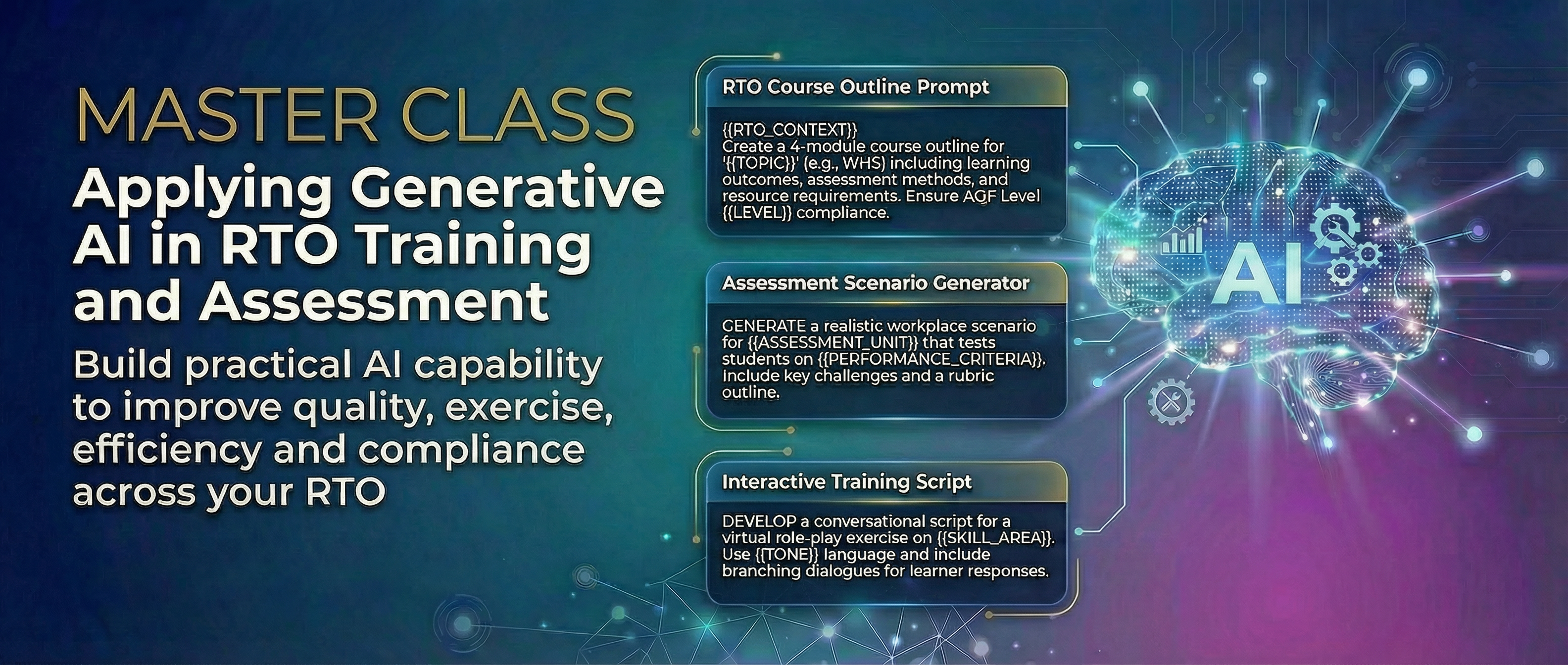
Build practical AI capability to improve quality, efficiency and compliance across your RTO.
- How can you apply AI in your RTO
Generative AI is no longer a future issue for RTOs. It is already influencing how training is designed, resources are developed, learners are supported, and quality systems operate. The challenge is no longer whether AI will be used, but how to apply it safely, effectively and strategically within an RTO context.
What will you learn
This two-day master class will show you how to use generative AI as a practical enabler of better training, stronger assessment support, smarter resource development, and more efficient operational workflows. Rather than treating AI as a novelty or a content shortcut, the program positions it as an intelligent partner that can help RTO professionals improve performance, accelerate routine tasks, and create more responsive learning and compliance systems.
You will examine where AI can add value across learning design, assessment support, learner services, reporting, and quality assurance.
The session will unpack the difference between traditional automation and generative AI, explore prompting techniques that improve output quality, and demonstrate how AI can support content creation, curation, adaptation, and workflow optimisation. This includes practical use cases relevant to RTOs and corporate training teams operating under increasing quality, efficiency, and governance pressures.
Importantly, the workshop also addresses the controls that matter. You will learn how to review AI outputs critically, maintain human oversight, identify hallucinations, bias and poor-quality content, and strengthen governance settings so the use of AI aligns with learners, industry and ASQA’s expectations. The focus is not on replacing professional judgement, but on amplifying capability while preserving integrity, compliance, and educational value.
Why you need to attend this workshop
Generative AI is already entering RTO practice, but in many organisations its use is still inconsistent, poorly controlled, and difficult to defend. Trainers and assessors are hearing bold claims, yet many still lack practical guidance on what is useful, safe, and appropriate in training and assessment. Meanwhile, resource development, assessment support, reporting, and quality processes are taking too much time while expectations keep rising.
This master class shows you where generative AI can add real value across training, assessment support, learner services, and operations. You will learn how to use it with stronger judgement, clearer boundaries, and immediate practical application. With AI capability moving faster than most RTO systems and staff readiness, delaying action increases the risk of fragmented use, inconsistent quality, and weak governance. This session gives you a practical way to get ahead.
Upcoming dates
Objective
Learning
By the end of the Workshops, participants will be able to:
- Differentiate traditional AI, machine learning, deep learning, and generative AI, and explain at least three implications for RTO training, assessment, learner support, or quality assurance.
- Identify and evaluate at least four RTO processes where generative AI can safely augment human work, and justify the governance controls needed for each use case.
- Analyse AI-generated learning or assessment content against the Principles of Assessment and Rules of Evidence, and document at least three risks and three corrective actions before implementation.
- Develop and test fit-for-purpose prompts that generate usable first drafts of learning activities, communications, policy content, or resource updates for immediate workplace application.
Application
Following the master class, participants will:
- Within four weeks of the webinar, document at least two AI‑enabled workflows (for example, TAS drafting, assessment tool updates or marketing copy) in their RTO QMS, including clear human review points.
- Within 6 weeks, trial generative AI on a real training, assessment, compliance, or administration task and record baseline versus post-implementation time, quality, and rework data.
- Within 6 weeks, brief their manager or team on AI opportunities, limitations, and governance requirements using a one-page summary tailored to their RTO context.
- Within 8 weeks, update or propose one policy, procedure, work instruction, or operational guideline that clarifies acceptable AI use, review responsibilities, and evidence retention expectations.
Impact
At the RTO / business level, the program aims to:
- Within 6 months, reduce average development time for selected training or assessment resources by at least 20% while maintaining internal QA or validation acceptance rates.
- Within 6 months, reduce rework caused by poor first-draft resource quality or compliance issues in selected AI-supported processes by at least 15%.
- Within 6 months, improve staff confidence in approved AI workflows by at least 25%, as measured through internal pulse surveys, feedback tools, or capability reviews.
- Within 12 months, demonstrate measurable reinvestment of AI-enabled time savings into learner support, validation, continuous improvement, resource quality, or innovation initiatives.
Who Should Attend?
- CEOs and RTO managers
- Training managers and heads of learning
- Compliance and quality managers
- Trainers and assessors
- Instructional designers and resource developers
- Student support, administration, and operations staff
- VET consultants supporting RTO systems, resources, or compliance
- Corporate training and L&D professionals working in regulated or quality-driven settings
What is included
Your registration includes a facilitated master class delivered either face-to-face over two full days from 9:00 am to 4:30 pm, or online over four consecutive days from 1:00 pm to 4:30 pm.
Across the program, you will work through guided activities, practical RTO examples, AI prompt frameworks, workflow ideas, implementation tools, ready-to-use templates, and a practical prompt library to support immediate application in your workplace.
Participants also receive a Certificate of Participation and 25 CPD points.
The program is designed not only to build knowledge, but to strengthen practical capability, improve workplace application, and generate measurable organisational impact.
SPEAKER

Javier
Amaro
CEO - Insources Group
Javier is the director and founder of Insources, a privately owned Australian training and consulting organisation. He has more than 18 years experience in the vocational and technical education world and has contributed to the Australian VET sector by designing and delivering more than 500 training programs to training managers, supervisors, facilitators, trainers and assessors
Agenda
Feedback from previous Workshops
participants
The session was incredibly informative and engaging! The content and activities were well-structured, easy to follow and directly applicable to RTOs.

This was a very well organized and well-presented learning session. Javier was great, showed great patience and answered all questions timely and clearly.
I really appreciated the resource documentation and how the presenter went through each of those documents and how to utilise them
I found the webinar extremely helpful. Javier did an amazing job answering questions and explaining each step.
Thank you for the very informative session. I look forward to registering for sessions like this in the near future.